


Indigenous Focus Day in action: Learning through story, land and design
This story is part of a series where staff participated in Indigenous Focus Day on April 20, 2026. Indigenous Focus Day is a district-wide professional development day dedicated to deepening educators’ understanding of Indigenous perspectives, histories and ways of knowing.
As part of Indigenous Focus Day, staff at Point Grey Secondary took part in a keynote and hands-on workshops designed to deepen their understanding of Indigenous ways of knowing, being and learning. Through these sessions, educators explored how to bring more holistic, place-based and relational approaches into classrooms across the district.
Keynote speaker: Jo-Ann Archibald
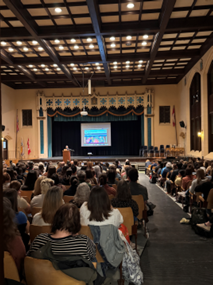 The day featured a keynote from Jo-Ann Archibald (Q’um Q’um Xiiem), a respected Stó:lō educator and scholar whose work in Indigenous Storywork has shaped Indigenous education across Canada. A professor emerita at UBC and Officer of the Order of Canada, Archibald shared how story can guide teaching and learning in meaningful and transformative ways.
At the centre of her message was the concept of Indigenous Storywork and emergence. She described learning as an ongoing process of becoming, one that unfolds over time through experience, relationships and context. This approach reflects the First Peoples Principles of Learning, which emphasize that learning is holistic, experiential and rooted in memory, story and place.
Archibald also highlighted how Indigenous knowledge systems can support learning across subject areas, including literacy, math and STEAM. Drawing on resources such as From Stars Above to Water Below, Archibald demonstrated how concepts like patterns, relationships and systems can be explored through connections to land, sky and water. These approaches support deeper engagement and allow students to see learning as connected and relevant to their lives.
Her teachings emphasized the importance of experiential and place-based learning. Taking students outside, learning from the land and connecting with community were all identified as powerful ways to support understanding. This approach also creates space for intergenerational learning and brings together heart, mind, body and spirit in the learning process.
Workshop: Build Your Own Engineering Design Challenge
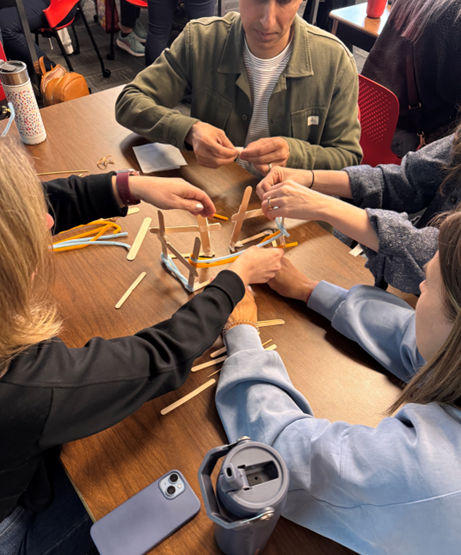 Following the keynote, educators participated in workshops across the district. One session, led by UBC Geering Up’s Indigenous STEAM program, focused on building fishing weirs as a hands-on engineering challenge that connects traditional knowledge with modern classroom practice.
Fishing weirs are a traditional method used by First Peoples in coastal communities to sustainably capture fish. In the workshop, participants worked in small groups to design and build their own weir prototypes using simple materials such as pipe cleaners, popsicle sticks, tape and string.
“This is exactly what we want for students. They plan, try, reflect and improve. It builds perseverance and shows the value of learning from others,” said Kim, Grade 1 teacher from Gordon Elementary.
Together, the keynote and workshop highlighted the power of connecting Indigenous knowledge with classroom practice in ways that are authentic and meaningful. By grounding learning in story, land and lived experience, educators can create opportunities for students to engage more deeply, think critically and build stronger connections to the world around them.
Indigenous Focus Day continues to support staff across the district in building knowledge, confidence and capacity to bring these approaches into their classrooms, strengthening learning for all students.